
Sustainable Weight Loss Starts with the Right Foundation
If you’re here, chances are you’re ready for a different approach to weight loss—one that doesn’t rely on restriction, guilt, or chasing perfection. Sustainable weight loss isn’t about having more willpower; it’s about using the right strategy for your real life.
Nutrition and exercise matter, of course. But so do stress, emotional well-being, and daily routines that actually fit your schedule. Lasting weight loss happens when you address both the science of metabolism and the human side of behavior change.
That means reconnecting with your values, strengths, and lived experience—and using them to build habits that feel supportive, flexible, and realistic over time.
In this two-part series, I’ll walk you through the foundational, science-backed principles of sustainable weight loss. These aren’t strict rules or one-size-fits-all plans—they’re flexible guidelines that help busy women achieve a happy, healthy weight in a way that lasts.
Define Your “Why”: The Mindset Shift Behind Sustainable Weight Loss
Change is hard — and lasting change is often uncomfortable. Sustainable weight loss happens when your desire to grow becomes stronger than your desire to stay the same.
Chasing a number on the scale isn’t enough to sustain long-term weight loss. While wanting to look and feel better is a valid starting point, lasting results require a deeper reason — one rooted in your values, identity, and the life you want to live.
Start by asking yourself: Why do I want to lose weight? Then go further. How will your daily life improve? How will you feel in your body, your energy, your confidence, and your ability to show up for what matters most?
This deeper motivation — your “Why” — anchors your behavior on the days when motivation fades. Weight loss becomes less about control and more about alignment. You’re not just changing habits; you’re reinforcing the person you’re becoming.
And here’s the truth: you already have what you need. Strengths like perseverance, curiosity, creativity, and self-awareness are powerful tools for change. When you lead with your strengths and stay anchored to your “Why,” change doesn’t just happen. It becomes permanent.
Progress Over Perfection: The Key to Consistent, Sustainable Weight Loss
When you view weight loss through a glass-half-empty lens, it’s easy to fall into all-or-nothing thinking. One “off” meal or missed workout can quickly spiral into discouragement — and eventually, disengagement.
But sustainable weight loss isn’t built on perfection. It’s built on consistency. Showing up imperfectly, even when life is messy, is what creates lasting change. Small, repeatable choices compound over time — and progress, not perfection, is what moves the needle.
Here’s the hard truth: sustainable weight loss isn’t a destination. It’s a skill. One that’s developed by learning how to navigate busy schedules, low motivation days, and unexpected disruptions — without giving up.
Instead of fixating on what didn’t go perfectly, shift your focus to what did go right. Celebrating small wins builds confidence and reinforces the identity of someone who follows through.
And when the process feels uncomfortable (because it will), lead with curiosity and self-compassion.
Consistency isn’t about doing everything right — it’s about persevering, adjusting, and trusting that every step forward counts.
Metabolism Matters: Why Undereating Makes Weight Loss Harder
Consistency is what keeps you moving forward — but consistency is nearly impossible when your body is under-fueled. That’s where metabolism comes in, and why eating enough is one of the most overlooked principles of sustainable weight loss.
You hear the phrase “boost your metabolism” everywhere in the weight loss space — but what does that actually mean?
Your metabolism refers to all the processes your body uses to convert food into energy so you can think clearly, move your body, manage stress, and get through your day. While factors like age and genetics play a role, others — including muscle mass, food choices, daily movement, and strength training — are well within your control.
Here’s what doesn’t work: chronic undereating.
Many busy women try to lose weight by skipping meals, eating the lowest-calorie options possible, or cutting out entire food groups. While this may lead to short-term weight loss, under-fueling sends your body into conservation mode. Digestion slows, hormone balance is disrupted, lean muscle is broken down, and your metabolism adapts to survive — not to burn fat efficiently.
The result? Fat loss stalls, energy plummets, cravings increase, and consistency becomes nearly impossible.
What does work is eating enough to support your body and your lifestyle.
Prioritize Protein
Protein plays a critical role in sustainable weight loss. It helps you feel full, curbs cravings, preserves lean muscle, and supports a healthy metabolic rate. Most women benefit from evenly distributing protein throughout the day, aiming for at least 25–30 grams per meal. A general guideline is 1.2–1.6 grams of protein per kilogram of body weight (or 0.5–0.7 grams of protein per pound), adjusted for activity level and goals.
Eat More Plants
Plant foods are rich in fiber — a nutrient that supports fullness, digestion, blood sugar balance, and long-term weight management. Because fiber adds volume without adding calories, it naturally helps regulate appetite. Emerging research also shows fiber supports a healthy gut microbiome, which plays a role in appetite regulation and metabolic health.
Think of plants as the anchor of your plate — fruits, vegetables, whole grains, beans, and legumes — then build around them with quality proteins and healthy fats. Most women benefit from 25–38 grams of fiber per day, spread across meals.
Yes, a calorie deficit is required for fat loss — but it’s not about eating less food.
A better reframe is this: when you eat more protein and fiber, you naturally eat less overall, without fighting hunger or willpower.
Once you understand how to fuel your body properly, the next step is learning how to apply these principles in real life — even on busy, unpredictable days.
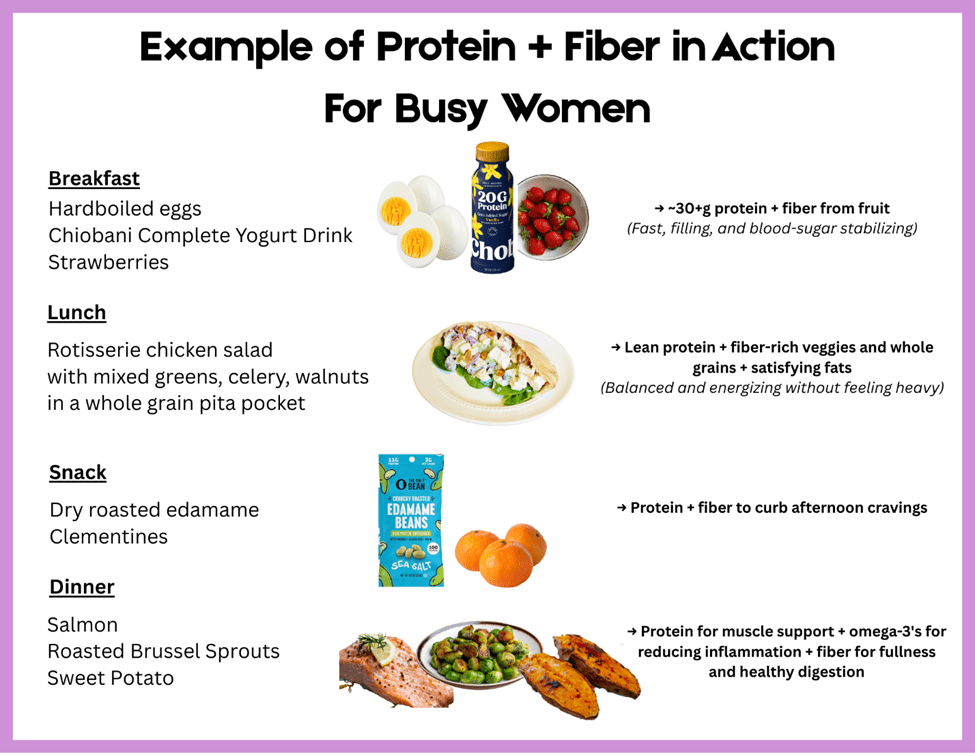
This isn’t a “perfect” day — it’s a realistic one. Meals can be swapped, simplified, or repeated based on your schedule.
Once you understand what your body needs — enough fuel, protein, fiber, and consistency — the real challenge becomes applying these principles in daily life.
Ready to put these principles into action?
In Part 2, I’ll show you how to apply these foundations to real life — busy days, imperfect weeks, and all.
 Glass Half Full Nutrition
Leave a comment